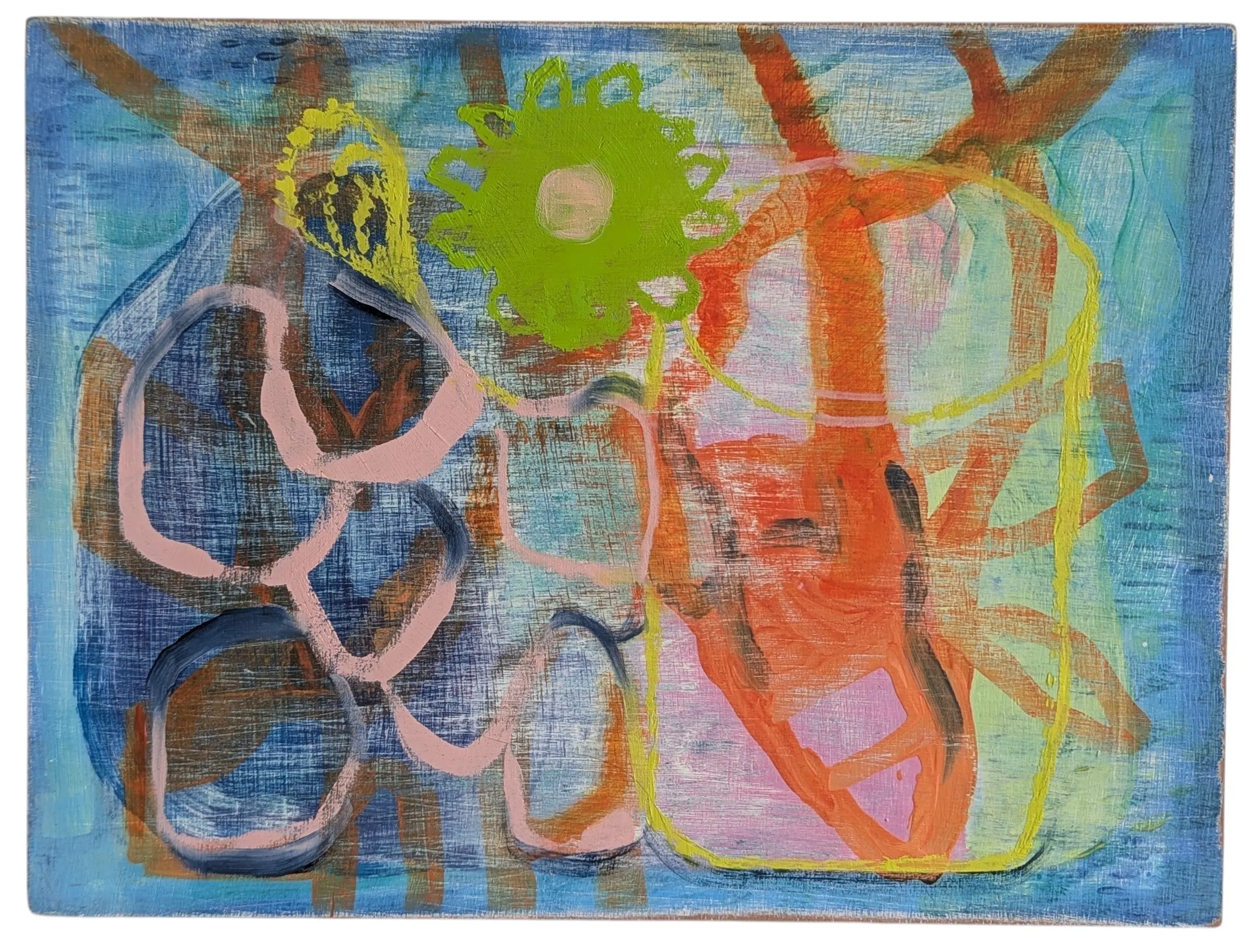
A Vase Without Flowers and Fish operates in a space between abstraction and emergent figuration, where forms appear less as fixed objects and more as unstable psychic events. The title names what isn’t quite there: a vase suggested rather than stated, flowers absent, a fish that may or may not be a fish. The translucent layering of oil and acrylic on wood panel creates a permeable pictorial field in which gestures, symbols, and spatial cues drift in and out of legibility. Rather than resolving into a coherent image, the work sustains a state of becoming.
Presence, Absence, and the Structure of the Painting
The composition is structured through a loose tension between two dominant zones: the darker blue network of looping, cellular forms on the left and the warmer orange-red vertical structure on the right. These elements suggest bodily, botanical, or anatomical references without settling into any one reading. The lime-green radial form near the top centre acts almost as a temporary anchor, evoking a flower, eye, sun, or organism — the absent flower of the title hovering without quite arriving. Such mutable imagery aligns the work with contemporary abstract figurative painting practices that privilege associative perception over representation.
Mark-Making Between Doodle, Diagram, and Automatic Writing
The painting’s visual language recalls aspects of post-gestural abstraction, where mark-making becomes both intuitive and semiotic. The drawn lines hover between doodle, diagram, and automatic writing. Their apparent informality resists compositional hierarchy, yet the painting remains carefully balanced through colour temperature, transparency, and rhythm. The exposed grain of the wood panel and the thin washes contribute to a sense of vulnerability and openness, allowing the surface itself to participate in the image.
Embodied Perception and the Instability of Inner and Outer Worlds
Within a contemporary framework, the work engages with embodied perception and the instability of inner and outer worlds. The forms feel simultaneously organic and psychological, as though memory, sensation, and environment are bleeding into one another. There is also a productive oscillation between innocence and unease. The bright palette and playful looping lines initially suggest spontaneity or childlike freedom, but the darker understructures and partially obscured marks complicate that reading, introducing ambiguity and tension.
The painting shares affinities with artists who merge abstraction and figuration through intuitive spatial construction, in which images arise from the act of painting itself rather than from predetermined motifs. Its strength lies in its refusal to declare what it is — or what it contains fully. Instead, it invites viewers into a speculative perceptual space where meaning remains fluid, provisional, and bodily felt rather than intellectually fixed.

Leave a Reply